

Nel cuore antico della città, tra la facciata romanico-gotica della cattedrale e il Palazzo Vescovile, si erge il Palazzo di Città, sede del Municipio. Oggi si presenta con un loggiato quattro-cinquecentesco a due grandi campate con volta a crociera: è la Loggia del Parlamento, così chiamata per le funzioni pubbliche cui essa fu destinata dall’epoca medievale in avanti. A fianco del portone d’ingresso del Municipio resistono gli infissi lignei dell’antica farmacia “Crocetti” accanto alla quale è murata una “canna”, l’antica misura locale a servizio delle transazioni che si volgevano in quello spazio voltato.
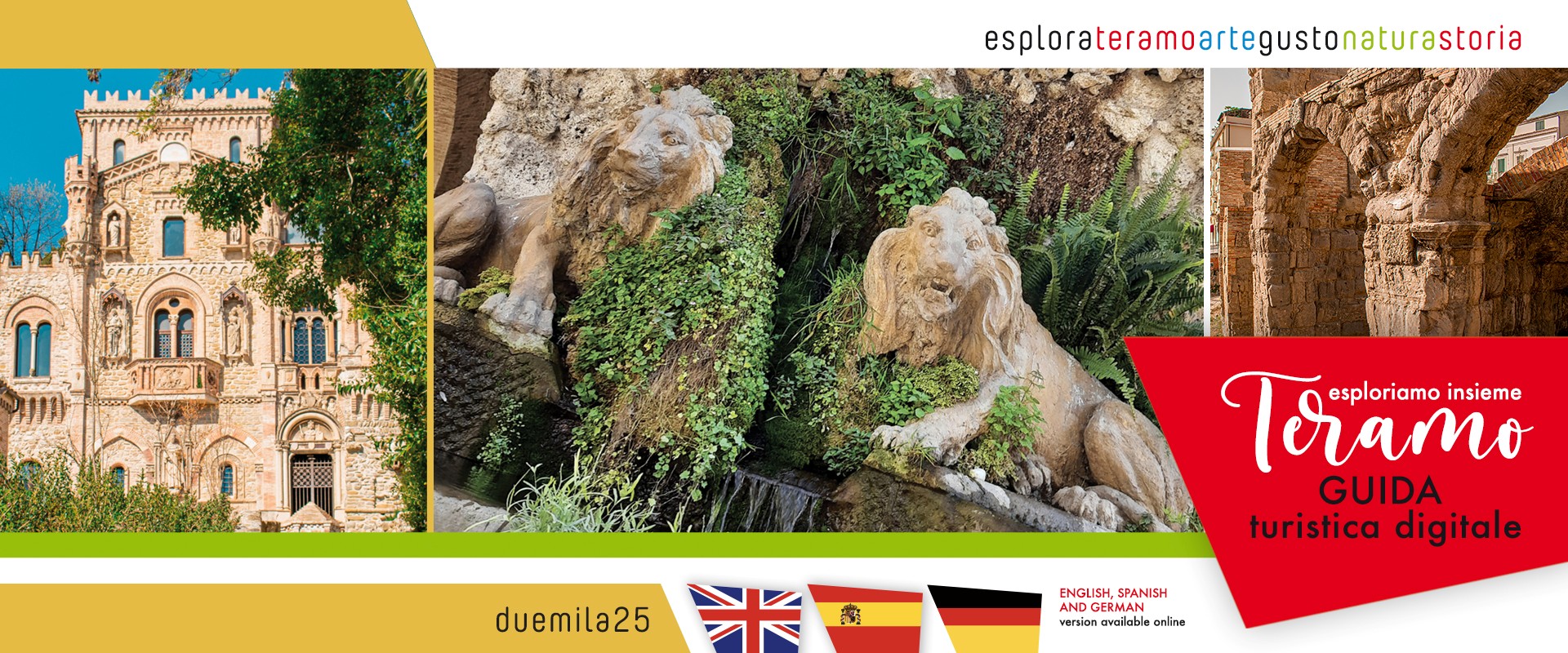
Su quella che un tempo era la Piazza del Mercato, troviamo, addossata al Palazzo del Comune, la Fontana dei leoni, risalente al 1899 e realizzata dallo scultore teramano Pasquale Morganti per solennizzare l’inaugurazione del primo acquedotto cittadino.
Di fronte al Palazzo di Città, ma con ingresso su Piazza Martiri della Libertà, si erge il Palazzo Vescovile.
Si tratta di un edificio quadrangolare che nel tempo ha perso molto dell’antico aspetto. Oggi l’ingresso su Piazza Martiri presenta una gradevole loggetta trecentesca, mentre resti di archi tamponati sono riaffiorati sul fianco sinistro dell’edificio in seguito ai restauri degli anni 2000. Di rilievo il porticato posto sul retro del Palazzo che guarda Piazza Orsini. Si tratta di un complesso di archi ogivali trecenteschi attribuibili alla volontà del Vescovo Niccolò degli Arcioni.
Testo di Luigi Ponziani
“Scopri Teramo”
In the ancient heart of the city, between the Romanesque-Gothic façade of the cathedral and the Bishop's Palace, stands the Palazzo di Città, seat of the Town Hall. Today it has a fifteenth-sixteenth-century loggia with two large spans with a cross vault: it is the Loggia del Parliament, so called for the public functions to which it was intended from medieval times onwards. Next to the entrance door of the Town Hall, the wooden window frames of the ancient "Crocetti" pharmacy resist, next to which a "barrel" is walled up, the ancient local measure at the service of the transactions that took place in that vaulted space.
On what was once the Market Square, we find, leaning against the Town Hall, the Fountain of the lions, dating back to 1899 and created by the sculptor Pasquale Morganti from Teramo to solemnize the inauguration of the first city aqueduct.
In front of the Palazzo di Città, but with the entrance on Piazza Martiri della Libertà, stands the Palazzo Vescovile.
It is a quadrangular building that has lost much of its ancient appearance over time. Today the entrance to Piazza Martiri has a pleasant fourteenth-century loggia, while the remains of buffered arches have resurfaced on the left side of the building following the restoration in the 2000s. The portico at the back of the building overlooking Piazza Orsini is of particular importance. It is a complex of fourteenth-century pointed arches attributable to the will of Bishop Niccolò degli Arcioni.
Text by Luigi Ponziani
"Scopri Teramo"
En el corazón antiguo de la ciudad, entre la fachada románico-gótica de la catedral y el Palacio Episcopal, se encuentra el Palazzo di Città, sede del Ayuntamiento. Hoy en día presenta una logia de los siglos XV-XVI de dos grandes luces con bóveda de crucería: se trata de la Logia del Parlamento, llamada así por las funciones públicas a las que fue destinada desde la época medieval. Junto a la puerta de entrada del Ayuntamiento se conservan los marcos de madera de la antigua farmacia "Crocetti", junto a la cual se encuentra tapiada una "canna", antigua medida local al servicio de las transacciones que se desarrollaban en ese espacio abovedado.
En la antigua Plaza del Mercado se encuentra, junto al Ayuntamiento, la Fuente de los Leones, que data de 1899 y fue creada por el escultor de Teramo Pasquale Morganti para solemnizar la inauguración del primer acueducto de la ciudad.
Frente al Palacio de la Ciudad, pero con entrada por la Piazza Martiri della Libertà, se encuentra el Palacio Episcopal.
Es un edificio cuadrangular que con el tiempo ha perdido gran parte de su aspecto antiguo. Hoy en día, la entrada en Piazza Martiri tiene una agradable logia del siglo XIV, mientras que los restos de arcos revestidos han resurgido en el lado izquierdo del edificio después de las restauraciones de la década de 2000. Destaca el pórtico en la parte trasera del edificio que da a Piazza Orsini. . Se trata de un complejo de arcos apuntados del siglo XIV atribuibles a la voluntad del obispo Niccolò degli Arcioni.
Texto de Luigi Ponziani
“Descubre Téramo”
Im alten Herzen der Stadt, zwischen der romanisch-gotischen Fassade der Kathedrale und dem Bischofspalast, steht der Palazzo di Città, der Sitz des Rathauses. Heute präsentiert es sich mit einer Loggia aus dem 15. und 16. Jahrhundert mit zwei großen Jochen und einem Kreuzgewölbe: Es handelt sich um die Parlamentsloge, die aufgrund der öffentlichen Funktionen, für die sie seit dem Mittelalter vorgesehen war, auch so genannt wurde. Neben der Eingangstür des Rathauses sind die Holzfensterrahmen der alten „Crocetti“ zu sehen. Apotheke noch vorhanden. daneben wurde eine „Canna“ eingemauert, das antike lokale Maß, das für die Transaktionen diente, die in diesem gewölbten Raum stattfanden.
Auf dem ehemaligen Marktplatz befindet sich, an das Rathaus gelehnt, der Löwenbrunnen aus dem Jahr 1899, der vom Bildhauer Pasquale Morganti aus Teramo anlässlich der Einweihung des ersten Aquädukts der Stadt geschaffen wurde.
Gegenüber dem Rathaus, aber mit einem Eingang an der Piazza Martiri della Libertà, steht der Bischofspalast.
Es handelt sich um ein viereckiges Gebäude, das im Laufe der Zeit viel von seinem alten Aussehen verloren hat. Heute verfügt der Eingang an der Piazza Martiri über eine schöne Loggia aus dem 14. Jahrhundert, während nach den Restaurierungsarbeiten in den 2000er Jahren auf der linken Seite des Gebäudes Reste blockierter Bögen wieder zum Vorschein gekommen sind. Bemerkenswert ist der Portikus auf der Rückseite des Palastes mit Blick auf die Piazza Orsini. Es handelt sich um einen Komplex aus Spitzbögen aus dem 14. Jahrhundert, der auf den Willen des Bischofs Nikolaus von Arcion zurückzuführen ist.
Text von Luigi Ponziani
„Entdecken Sie Teramo“