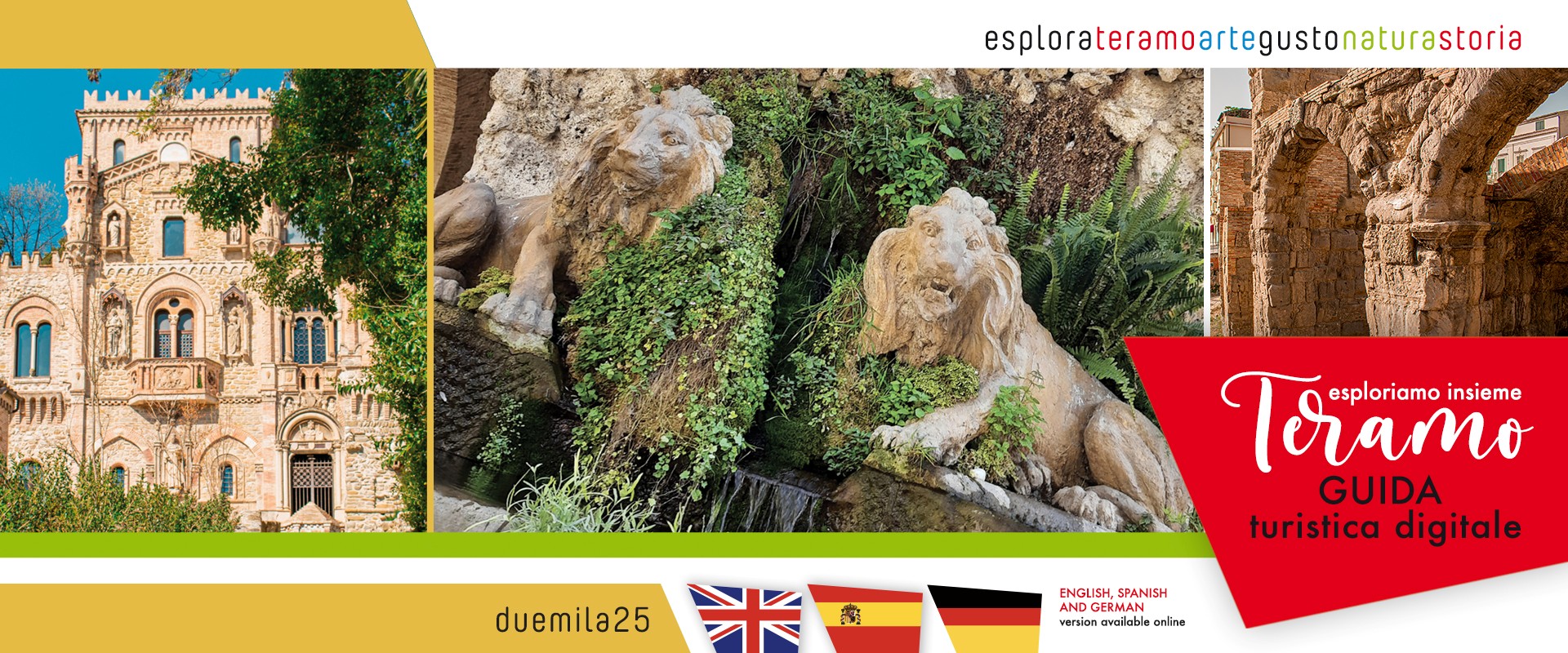

Intorno alla seconda metà del XV secolo Teramo vede la costruzione di Casa Catenacci, diventata Casa Corradi fino alla fine dell’800 e con la morte dell’ultimo erede della famiglia divenne Casa Capuani, dal nome dei nuovi. Oggi il palazzo è di proprietà della famiglia Franchi.
Situata all’interno del quartiere di S. Spirito, presenta un bel portico ad archi ogivali su pilastri, un portale a ogiva, realizzato in conci di pietra molto simile a quello del Palazzo Vescovile.
Sulla facciata che guarda Via Vittorio Veneto, si trova un emblema lapideo, che possiamo datare 1510 che recita un motto tanto famoso durante l’epoca rinascimentale “S.A. NON BENE PRO TOTO LIBERTAS VENDITUR AURO” tradotto “La libertà non si vende per tutto l’oro del mondo”.
Il motto può essere definito come un ammonimento orgoglioso della famiglia Corradi.
Casa Corradi, grazie alla sensibilità delle famiglie Corradi e Gatti, dal 1792 fino all’inaugurazione del Teatro Comunale ottocentesco nel 1868, malauguratamente demolito nel 1959, ospitò il teatro della città.
Around the second half of the 15th century, Teramo saw the construction of Casa Catenacci, which became Casa Corradi until the end of the 19th century and with the death of the last heir of the family it became Casa Capuani, named after the new ones. Today the building is owned by the Franchi family.
Located within the neighborhood of S. Spirito, it has a beautiful portico with pointed arches on pillars, a pointed portal, made of stone blocks very similar to that of the Bishop's Palace.
On the facade overlooking Via Vittorio Veneto, there is a stone emblem, which we can date from 1510 which recites a motto so famous during the Renaissance period "S.A. NOT BENE PRO TOTO LIBERTAS VENDITUR AURO" translated "Freedom is not sold for all the gold in the world ".
The motto can be defined as a proud warning from the Corradi family.
Casa Corradi, thanks to the sensitivity of the Corradi and Gatti families, housed the city theater from 1792 until the inauguration of the nineteenth-century Municipal Theater in 1868, unfortunately demolished in 1959.
Hacia la segunda mitad del siglo XV, en Teramo se construyó la Casa Catenacci, que se convirtió en Casa Corradi hasta finales del siglo XIX y con la muerte del último heredero de la familia pasó a ser Casa Capuani, que lleva el nombre de los nuevos. Hoy el palacio es propiedad de la familia Franchi.
Situado en el barrio de S. Spirito, tiene un hermoso pórtico con arcos apuntados sobre pilares, un portal apuntado, realizado con sillares de piedra muy similar al del Palacio Episcopal.
En la fachada que da a Via Vittorio Veneto se encuentra un emblema de piedra, que podemos remontar al año 1510, que recita un lema tan famoso en el Renacimiento: “S.A. NON BENE PRO TOTO LIBERTAS VENDITUR AURO” traducido “La libertad no se puede vender por todo el oro del mundo”.
El lema se puede definir como una orgullosa advertencia de la familia Corradi.
Casa Corradi, gracias a la sensibilidad de las familias Corradi y Gatti, acogió el teatro de la ciudad desde 1792 hasta la inauguración del Teatro Municipal del siglo XIX en 1868, lamentablemente demolido en 1959.
Etwa in der zweiten Hälfte des 15. Jahrhunderts wurde in Teramo die Casa Catenacci errichtet, die bis zum Ende des 19. Jahrhunderts den Namen Casa Corradi trug und nach dem Tod des letzten Erben der Familie in Casa Capuani umbenannt wurde, nach dem Namen der Neueren. Heute ist der Palast im Besitz der Familie Franchi.
Es befindet sich im Viertel S. Spirito und verfügt über einen wunderschönen Portikus mit Spitzbögen auf Säulen, ein spitzbogiges Portal aus Steinblöcken, das dem des Bischofspalastes sehr ähnlich ist.
An der Fassade zur Via Vittorio Veneto befindet sich ein Steinemblem, das auf das Jahr 1510 datiert werden kann und das während der Renaissance so berühmte Motto „S.A.“ wiedergibt. NOT BENE PRO TOTO LIBERTAS VENDITUR AURO" übersetzt „Freiheit. Sie lässt sich nicht für alles Gold der Welt verkaufen."
Das Motto kann als stolze Ermahnung der Familie Corradi definiert werden.
Dank der Sensibilität der Familien Corradi und Gatti beherbergte das Casa Corradi von 1792 bis zur Eröffnung des Teatro Comunale aus dem 19. Jahrhundert im Jahr 1868, das leider 1959 abgerissen wurde, das Stadttheater.