 Situata tra le colline della provincia teramana, Campli è una cittadina caratterizzata da un rilevante patrimonio storico e artistico. Il suo illustre passato vive ancora oggi nelle testimonianze conservate nel centro storico. Il territorio camplese è stato abitato sin dall’antichità, come testimonia la Necropoli di Campovalano, utilizzata dal XII al II secolo a.C. Questo sito archeologico, tra i più significativi della regione, evidenzia l’importanza della zona già in epoca preromana. Sono state rinvenute alcune monete nei pressi della frazione di Battaglia, a conferma dell’intensa attività economica del passato.
Di particolare rilevanza sono alcuni reperti che collegano Campli alla storia romana: un frammento di epigrafe dedicata a Giulio Cesare, scoperto sotto l’altare della chiesa di San Pietro a Campovalano; il piedistallo di una statua o frontone di un tempio, costruito secondo la Legge Rufrena del 44 a.C.; un frammento di sarcofago attribuito ad Aurelio Andronico, databile IV secolo d.C.
Nel 462 a.C., con la sottomissione dei Sanniti e dei Pretuzi, la regione cadde sotto il dominio romano, segnando l’inizio di un lungo periodo di integrazione culturale e politica. A metà del XIV secolo Campli raggiunse una posizione di rilievo divenendo Libero Comune. Questo status portò prosperità e un significativo incremento demografico, grazie anche ai privilegi concessi dai sovrani angioini e aragonesi. Nel 1293 la città aveva ottenuto il diritto di allestire un mercato settimanale.
Nel XV secolo, un ulteriore sviluppo del borgo, fu contraddistinto dall’immunità fiscale e da nuovi privilegi. Nel 1538 Campli divenne Feudo Farnesiano, vivendo un lungo periodo di prosperità.
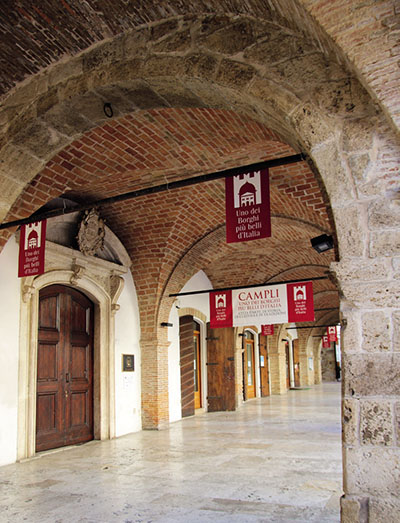
Palazzo Farnese, attualmente sede del municipio di Campli, rappresenta uno dei monumenti storici e architettonici più antichi d’Abruzzo. Affacciato su Piazza Vittorio Emanuele II, nel corso dei secoli l’edificio ha subito numerose modifiche e restauri. Il pianoterra presenta sette archi a tutto sesto sostenuti da pilastri, con un portico coperto da volte a crociera realizzate in mattoni. Il secondo livello si distingue per le sue sei trifore, ognuna dotata di un archetto centrale trilobato affiancato da due archetti a tutto sesto sorretti da eleganti colonnine. Su uno dei conci della facciata è inciso “CAMPII - MDXX”, che probabilmente si riferisce al 1520, anno delle prime modifiche significative apportate all’edificio. Nel 1902 è stato ufficialmente inserito nell’elenco dei Monumenti Nazionali Italiani, riconoscendo il suo valore storico, artistico e culturale.
 Percorrendo le vie del centro storico, degni di nota sono la Casa del Medico, con il suo doppio loggiato interno in travertino e una bella scalinata, e la Loggia dello Speziale, esempio di casa bottega rinascimentale con portico che serviva agli artigiani per lavorare e vendere merci al riparo.
Nel 1734, con il ritorno ai Borboni di Napoli, la città avviò un periodo di lenta ripresa. Nel XIX secolo, Campli fu segnata da eventi sfavorevoli: nel 1818 il vescovado fu abolito a seguito di un concordato tra la Santa Sede e il Regno delle Due Sicilie, mentre nel 1860 Campli fu attaccata dai soldati borbonici e dai briganti, che incendiarono e distrussero l’archivio comunale, causando la perdita di preziosi documenti storici.
Le antiche strade del borgo, i suoi monumenti e il ricco patrimonio culturale fanno di questa cittadina una testimonianza vivente delle diverse epoche che hanno segnato l’Italia.
Importante luogo di culto di Campli è il Santuario della Scala Santa, con annessa chiesa di San Paolo. L’edificio religioso venne costruito tra il 1772 e il 1776. L'accesso avviene attraverso un portale cinquecentesco in bugnato proveniente dal Convento di Sant’Onofrio. Costituisce una rinomata meta di pellegrinaggio alla quale papa Clemente XIV concesse nel 1772 le stesse indulgenze della nota Scala Santa di Roma.
 La scala, costituita da 28 gradini in legno d’ulivo, simboleggia un percorso spirituale per il credente, che la sale inginocchiato. Il percorso è impreziosito da tele e affreschi raffiguranti la Passione di Cristo. Alla sommità è posta la Cappella del Sancta Sanctorum, cuore religioso del santuario, dove si ammirano una tela del Cristo Salvator Mundi, le statue del Cristo Morto e dell’Addolorata, reliquie di martiri e due frammenti della S. Croce di Cristo, custoditi in reliquiari lignei di scuola napoletana. Un'altra scalinata, decorata da affreschi raffiguranti episodi evangelici, è riservata alla discesa. La bellezza artistica e l’intensa spiritualità del luogo lo rendono una meta di straordinario valore culturale e mistico, capace di affascinare ogni visitatore.
La Cattedrale di Santa Maria in Platea, situata nel cuore del borgo, presenta due stili differenti sulla facciata: romanico e neoclassico. L’edificio, a tre navate e con un elegante e imponente torre campanaria, ospita un maestoso soffitto ligneo realizzato da Donato Teodoro tra il primo e il secondo decennio del Settecento. Il campanile del XIII secolo fu abbellito con una cuspide alla fine del XV secolo dal Maestro Antonio da Lodi e rappresenta un eccezionale esempio di architettura lombarda.
La cripta della Cattedrale evidenzia una rara abilità pittorica e una profonda sensibilità artistica nei preziosi affreschi di scuola giottesca. Inoltre è sede del Santuario dedicato alla Madonna Immacolata, venerata come “Patrona, Regina, Avvocata e Protettrice” della città. Questa devozione risale al 1764, anno in cui la Vergine miracolosa libera la città di Campli da una violenta epidemia di febbri tifiche.
La Chiesa di San Francesco d’Assisi con annesso ex convento è caratterizzata da una facciata in conci di pietra squadrata e da un portale decorato. La coeva torre campanaria è stata ricostruita nel 1997. All’interno dell’edificio sacro sono presenti resti di notevoli affreschi trecenteschi. L’ex convento francescano è sede del Museo Archeologico Nazionale di Campli. Inaugurato nel giugno del 1988 conserva e valorizza i preziosi reperti della Necropoli di Campovalano, rinvenuti nel corso di trent’anni di scavi. Sono state riportate alla luce 610 sepolture risalenti a un periodo compreso tra l’Età del Ferro e l’impero romano (XII-II secolo a.C).
Presso la frazione di Nocella, la Torre del Melatino, rappresenta un importante esempio di architettura difensiva medievale. Costruita nel XIV secolo, nacque come struttura di avvistamento, segnalando eventuali incursioni nemiche e proteggendo le comunità locali. Alla nobile famiglia teramana dei Melatino è dedicato lo stemma incastonato sulla facciata occidentale della torre.
 Le manifestazioni estive trasformano il borgo in un vivace palcoscenico dove il passato si intreccia con il presente, attraverso sapori, profumi e antiche tradizioni. Uno degli eventi più attesi è la Sagra della Porchetta Italica, la più antica d’Abruzzo, che si svolge nella settimana successiva al Ferragosto. Dal 1964 questo appuntamento celebra l’arte gastronomica farnese, attirando migliaia di visitatori. Il momento clou della sagra è la premiazione del miglior maestro porchettaio dell’anno, riconoscimento che valorizza la sapiente lavorazione artigianale della porchetta di Campli, famosa per la speziatura e la lenta cottura nei forni a legna. Questo prodotto rappresenta uno dei simboli dell’eccellenza gastronomica locale.
Se vi trovate nei dintorni di Campli nella seconda settimana di luglio non potete perdere la Sagra del Tartufo di Campovalano, appuntamento gastronomico che, da oltre vent’anni celebra il pregiato tubero dei Monti Gemelli.
La settimana a cavallo tra la fine di luglio e i primi giorni di agosto è dedicata alla Sagra del Timballo a Floriano di Campli. Questo piatto tipico è uno dei più elaborati e gustosi della tradizione gastronomica farnese.
Dopo aver visitato Campli, partecipare agli appuntamenti gastronomici si trasformerà in un’esperienza autentica che vi farà vivere in perfetta sintonia con la cultura locale.
Ufficio Turistico del Comune di Campli
Piazza V. Emanuele II, n. 4 - Campli (TE)
Tel. 0861 5601207 • turismo@comune.campli.te.it
www.visitcampli.it
Located in the hills of the Teramo province, Campli is a town characterized by a significant historical and artistic heritage. Its illustrious past still lives today in the testimonies preserved in the historic center. The Campli area has been inhabited since ancient times, as evidenced by the Campovalano Necropolis, used from the 12th to the 2nd century BC. This archaeological site, among the most significant in the region, highlights the importance of the area already in pre-Roman times. Some coins have been found near the hamlet of Battaglia, confirming the intense activity economic history of the past.
Of particular importance are some finds that connect Campli to Roman history: a fragment of an epigraph dedicated to Julius Caesar, discovered under the altar of the church of San Pietro in Campovalano; the pedestal of a statue or pediment of a temple, built according to the Rufrene Law of 44 BC; a fragment of a sarcophagus attributed to Aurelius Andronicus, dating back to the 4th century AD.
In 462 BC, with the subjugation of the Samnites and the Pretuzi, the region fell under Roman rule, marking the beginning of a long period of cultural and political integration. In the mid-14th century Campli reached a prominent position by becoming a Free Municipality. This status brought prosperity and a significant population increase, thanks also to the privileges granted by the Angevin and Aragonese rulers. In 1293 the city had obtained the right to set up a weekly market.
In the 15th century, further development of the village was marked by tax immunity and new privileges. In 1538 Campli became a Farnese fiefdom, experiencing a long period of prosperity.
Palazzo Farnese, currently the seat of the town hall of Campli, represents one of the oldest historical and architectural monuments in Abruzzo. Overlooking Piazza Vittorio Emanuele II, the building has undergone numerous modifications and restorations over the centuries. The ground floor has seven round arches supported by pillars, with a portico covered by cross vaults made of bricks. The second level is distinguished by its six triple lancet windows, each with a central trilobate arch flanked by two round arches supported by elegant columns. On one of the ashlars of the façade is engraved “CAMPII - MDXX”, which probably refers to 1520, the year of the first significant modifications made to the building. In 1902 it was It was officially included in the list of Italian National Monuments, recognizing its historical, artistic and cultural value.
Walking through the streets of the historic center, noteworthy are the Casa del Medico, with its double internal travertine loggia and a beautiful staircase, and the Loggia dello Speziale, an example of a Renaissance shop-house with a portico that served artisans to work and sell goods under cover.
In 1734, with the return of the Bourbons of Naples, the city began a period of slow recovery. In the 19th century, Campli was marked by unfavorable events: in 1818 the bishopric was abolished following a concordat between the Holy See and the Kingdom of the Two Sicilies, while in 1860 Campli was attacked by Bourbon soldiers and bandits, who set fire to and destroyed the municipal archives, causing the loss of precious historical documents.
The ancient streets of the village, its monuments and rich cultural heritage make this town a living testimony to the different eras that have marked Italy.
An important place of worship in Campli is the Santuario della Scala Santa, with the adjoining Church of San Paolo. The religious building was built between 1772 and 1776. Access is through a sixteenth-century ashlar portal from the Convent of Sant’Onofrio. It is a renowned pilgrimage destination to which Pope Clement XIV granted the same indulgences as the famous Holy Stairs in Rome in 1772.
The staircase, consisting of 28 steps in olive wood, symbolizes a spiritual journey for the believer, who climbs it on his knees. The path is embellished with paintings and frescoes depicting the Passion of Christ. At the top is the Chapel of the Sancta Sanctorum, the religious heart of the sanctuary, where you can admire a canvas of Christ Salvator Mundi, the statues of the Dead Christ and Our Lady of Sorrows, relics of martyrs and two fragments of the Holy Cross of Christ, kept in wooden reliquaries of the Neapolitan school. Another staircase, decorated with frescoes depicting evangelical episodes, is reserved for the descent. The artistic beauty and intense spirituality of the place make it a destination of extraordinary cultural and mystical value, capable of fascinating every visitor.
The Cathedral of Santa Maria in Platea, located in the heart of the village, has two different styles on the facade: Romanesque and neoclassical. The building, with three naves and an elegant and imposing bell tower, houses a majestic wooden ceiling made by Donato Teodoro between the first and second decade of the eighteenth century. The 13th century bell tower was embellished with a spire at the end of the 15th century by Maestro Antonio da Lodi and represents an exceptional example of Lombard architecture.
The crypt of the Cathedral highlights a rare pictorial ability and a profound artistic sensitivity in the precious frescoes of the Giotto school. It is also seat of the Sanctuary dedicated to the Immaculate Madonna, venerated as the "Patron Saint, Queen, Advocate and Protector" of the city. This devotion dates back to 1764, the year in which the miraculous Virgin freed the city of Campli from a violent epidemic of typhoid fever.
The Church of San Francesco d’Assisi with an adjoining former convent is characterised by a façade in squared stone blocks and a decorated portal. The contemporary bell tower was rebuilt in 1997. Inside the sacred building there are remains of notable fourteenth-century frescoes. The former Franciscan convent is home to the National Archaeological Museum of Campli. Inaugurated in June 1988, it preserves and enhances the precious finds from the Campovalano Necropolis, discovered over thirty years of excavations. 610 burials dating back to a period between the Iron Age and the Roman Empire (12th-2nd century BC) were brought to light.
Near the hamlet of Nocella, the Melatino Tower represents an important example of medieval defensive architecture. Built in the 14th century, it was born as a lookout structure, signaling possible enemy incursions and protecting the local communities. The noble Melatino family from Teramo was responsible for the construction of the Melatino Tower. dedicated to the coat of arms set on the western facade of the tower.
The summer events transform the village into a lively stage where the past intertwines with the present, through flavors, aromas and ancient traditions. One of the most anticipated events is the Sagra della Porchetta Italica, the oldest in Abruzzo, which takes place in the week following Ferragosto. Since 1964, this event has celebrated the Farnese gastronomic art, attracting thousands of visitors. The highlight of the festival is the awarding of the best master porchettaio of the year, a recognition that enhances the expert craftsmanship of the Campli porchetta, famous for its seasoning and slow cooking in wood-fired ovens. This product represents one of the symbols of local gastronomic excellence.
If you find yourself in the Campli area in the second week of July, you cannot miss the Campovalano Truffle Festival, a gastronomic event that has celebrated the prized tuber of the Gemelli Mountains for over twenty years.
The week between the end of July and the first days of August is dedicated to the Timballo Festival in Floriano di Campli. This typical dish is one of the most elaborate and tasty dishes of the Farnese gastronomic tradition.
After visiting Campli, taking part in the gastronomic events will turn into an authentic experience that will make you live in perfect harmony with the local culture.
Campli Municipal Tourist Office
Piazza V. Emanuele II, n. 4 - Campli (TE)
Tel. 0861 5601207 • turismo@comune.campli.te.it
www.visitcampli.it